
Not to be confused with A.R. Sugden & Co!
James Edward Sugden, a native
of West Yorkshire, completed his education with E.M.I. Electronics in
London. After a stint as project engineer for Studio Sound with E.M.I.
broadcast equipment division, he spent a short time with Granada TV before
forming his own company, Research Electronics in 1960 which specialised
in small batch scientific instrumentation.
His passion for high quality sound reproduction ultimately caused Sugden
to enter the Hi-Fidelity amplifier market in the mid 1960’s with
a controversial design - a pure class A transistor power amplifier. By
definition Class A amplifiers exhibit a method of operation in which all
the transistors operate on linear portions of their transfer characteristics
all the time, the circuit drawing constant mean current from the power
supply irrespective of signal.
In contrast a class B type amplifier is one in which (usually) the output pair of transistors split positive and negative portions of the signal waveform between them. Because the transfer from one output transistor to the other is difficult to control, class B operation results in greatly increased distortion at low volumes, known as crossover distortion.
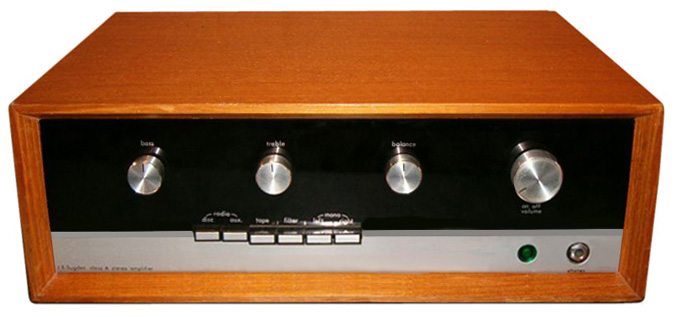
Sugden’s first class A amplifier was the Si402 power amplifier and matching Si401 pre-amplifier, both of which were produced in small quantities. This was followed in 1967 by the classic 10-watt per channel A21, the worlds first commercially produced solid state, Class-A amplifier.
The A21 was initially marketed by the well regarded loudspeaker manufacturer Richard Allan, however this relationship was relatively brief and in 1969 the A21 series 2 was re-released under Sugden's own name. (A21’s bearing the Richard Allan logo are quite rare and should be snapped up immediately!) Only one other Sugden-designed product was sold by the Richard Allen company, namely the A41/C41; a 20 watt per channel preamplifier/power amplifier combination.
The predominantly low order harmonic distortion (a natural phenomenon the human ear accepts and is not fatigued by) is one of the reasons the A21 sounds so good. Many audiophiles consider this to be the closest that a solid-state amplifier has come to sounding like a valve one.
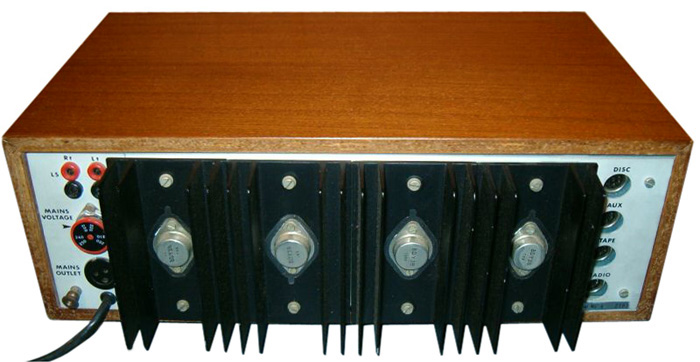
The 1969 A21Series Two Sugden integrated amplifier retailed for £56 (about £630 in today's money) and was cosmetically enhanced with a dual colour anodized front panel. Output power was improved to 12 watts per channel from the original 10 Watts. Total harmonic distortion was less than 0.2% at 10 watts, mainly 2nd harmonic and 3rd harmonic, less than 0.01% at 0.25 watts- i.e. the average power listening level. Frequency response was 30Hz-20kHz (±1dB) and signal to noise ratio 80dB.
Price when new: Richard Allen A21 £52, Sugden A21 series 2 £56. Today a complete but untested unit typically sells for between £50 - £80, nice, working examples for between £100 to £200 and fully restored between £250 to £300.
Sugden still sell a modern version of the A21
called the A21A. It is, naturally, a pure Class A amplifier and retails
for around £1200.
Click on a thumbnail
for enlargement